Ketamine Therapy for Bipolar Depression Palm Beach Gardens | Allay Health & Wellness
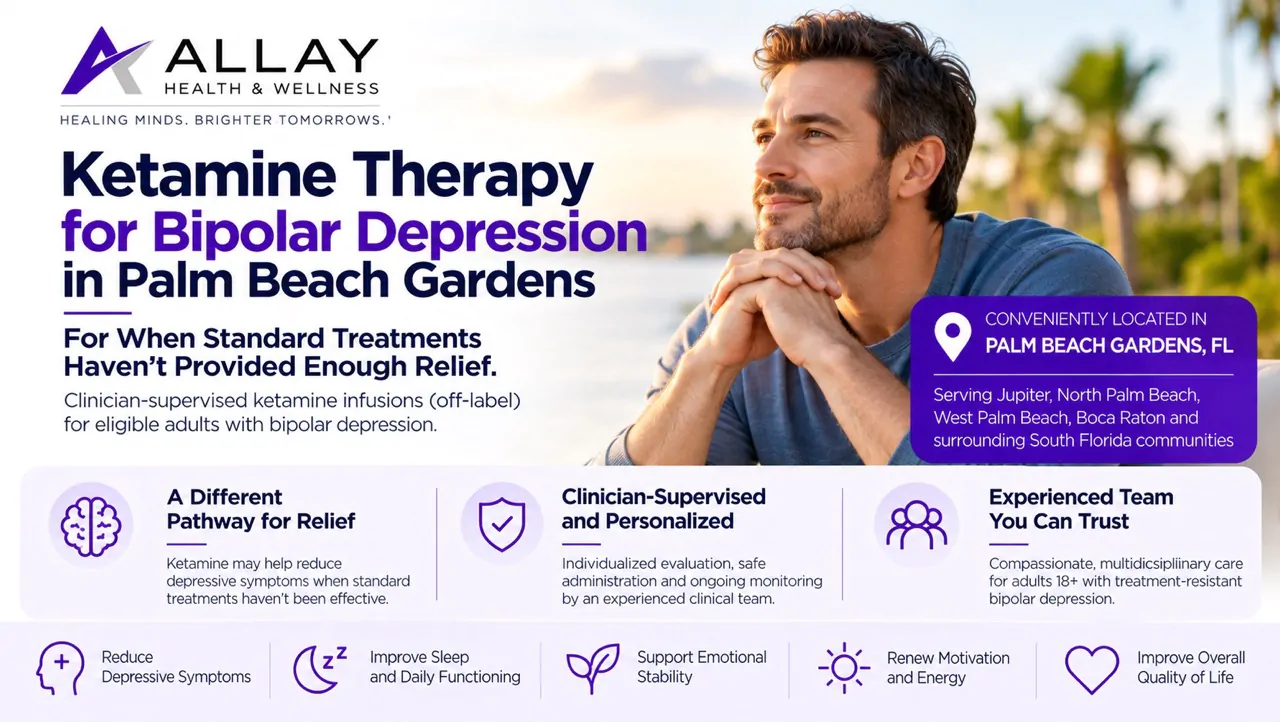
Bipolar depression is one of the most difficult depressive presentations to treat. The depressive episodes associated with bipolar disorder are often longer, more severe, and more resistant to standard antidepressants than unipolar major depressive episodes, yet the same antidepressants that anchor unipolar depression treatment can trigger manic or hypomanic episodes in bipolar patients. This leaves many adults with bipolar disorder cycling through inadequate treatment options, experiencing prolonged depressive episodes without effective relief. If you are exploring ketamine therapy bipolar depression Palm Beach Gardens options, Allay Health and Wellness offers clinically supervised IV ketamine infusions as an off label intervention for adults 18 and older with bipolar depression who have not responded adequately to standard mood management.
This page explains what bipolar depression is and what makes it so difficult to treat, the regulatory status of ketamine therapy bipolar depression Palm Beach Gardens treatment, how ketamine may help, critical safety considerations including mood stabilizer co-management, who may be a candidate, and what treatment at Allay looks like. Adults 18 and older with a bipolar disorder diagnosis and treatment resistant depressive episodes are the population this page specifically addresses.
Understanding Bipolar Depression: Why It Differs from Unipolar Depression
Bipolar disorder is a mood disorder characterized by episodic shifts between depressive states and elevated mood states, which may be manic (bipolar I) or hypomanic (bipolar II). The depressive phase of bipolar disorder, sometimes called the bipolar depressive episode, is symptomatically similar to unipolar major depression, with persistent low mood, loss of interest, fatigue, cognitive slowing, sleep disruption, feelings of worthlessness, and in severe cases suicidal ideation, but its treatment context is fundamentally different.
Standard antidepressant monotherapy, the backbone of unipolar depression treatment, carries real risk in bipolar disorder. Antidepressants can destabilize mood cycling, precipitate manic or hypomanic switches, and in some patients worsen the overall course of illness. Current clinical guidelines from the American Psychiatric Association recommend against antidepressant monotherapy in most bipolar depression presentations. Treatment instead centers on mood stabilizers such as lithium and valproate, atypical antipsychotics with mood stabilizing properties such as quetiapine and lurasidone, and lamotrigine for bipolar II. These agents reduce manic risk but often provide only partial depressive relief, leaving many patients with persistent depressive burden despite being on a technically appropriate mood stabilizer regimen.
The NIMH overview of bipolar disorder documents the substantial treatment gap in bipolar depression, noting that depressive phases account for the majority of time spent symptomatic in bipolar disorder and represent the greatest source of functional impairment. For adults 18 and older who have not achieved adequate relief from standard mood stabilizer regimens, ketamine therapy bipolar depression Palm Beach Gardens at Allay offers a supervised clinical pathway operating through a glutamatergic mechanism distinct from any currently approved mood stabilizer or antidepressant.
Regulatory Disclosure: Ketamine for Bipolar Depression Is Off Label
Before reviewing any clinical details, Allay Health requires the following regulatory disclosure for all prospective patients. Neither IV ketamine nor Spravato (esketamine) is FDA approved for the treatment of bipolar depression. This is the foundational fact every adult considering ketamine therapy bipolar depression Palm Beach Gardens treatment must understand before any evaluation proceeds.
IV ketamine is not FDA approved for any psychiatric indication. Its use for bipolar depression, unipolar major depression, PTSD, anxiety, or any other mental health condition is entirely off label. The FDA has not evaluated ketamine specifically for bipolar depression through its formal approval process. Spravato (esketamine nasal spray) is FDA approved for treatment resistant depression (TRD) and major depressive disorder with acute suicidal ideation, but these approvals were established in unipolar depression populations. Spravato is not FDA approved for bipolar depression. Its use in bipolar patients would be off label, and the REMS based insurance coverage pathway linked to Spravato applies only to its approved TRD and MDD with SI indications in unipolar populations.
At Allay, ketamine therapy bipolar depression Palm Beach Gardens treatment is delivered as IV ketamine infusions administered off label under the supervision of a licensed provider. Off label prescribing is legal and common in medicine. Published clinical research on ketamine in bipolar depression exists and is reviewed with every patient at intake. Allay discloses off label status explicitly at every stage of the intake and consent process. The NAMI resource on bipolar disorder provides additional background on diagnosis, treatment options, and recovery.
How Ketamine May Help Bipolar Depression: Mechanism and Evidence
The rationale for ketamine therapy bipolar depression Palm Beach Gardens treatment rests on ketamine’s mechanism as an NMDA receptor antagonist. Unlike standard antidepressants, which modulate monoamine systems (serotonin, norepinephrine, dopamine), ketamine acts on the glutamatergic system. Bipolar disorder involves glutamatergic dysregulation, and ketamine’s rapid modulation of NMDA receptors triggers a cascade of effects: BDNF release, synaptogenesis in prefrontal circuits, and restoration of synaptic connectivity. These produce antidepressant effects through a pathway distinct from both mood stabilizers and traditional antidepressants.
Critically, ketamine’s proposed antidepressant mechanism does not rely on the monoamine pathways that carry manic switch risk. This is one reason researchers have investigated ketamine specifically in bipolar depression: it may offer rapid antidepressant effects without the destabilizing monoaminergic push associated with SSRIs and SNRIs.
Published clinical data on ketamine therapy bipolar depression Palm Beach Gardens treatment comes from randomized controlled trials and observational studies. Studies have demonstrated significant reductions in bipolar depressive symptoms following IV ketamine infusions, often with onset within hours. Effect sizes have been clinically meaningful. Manic switch rates in published research have been low when patients were on concurrent mood stabilizers, though the evidence base is smaller than for unipolar depression and studies vary in design and population. This evidence context is presented to every patient at intake as part of informed consent. The International Bipolar Association clinical resources offer peer reviewed summaries of emerging treatment evidence that patients may reference.
Critical Safety Consideration: Mood Stabilizer Co-Management
This section addresses one of the most important safety requirements for any adult considering ketamine therapy bipolar depression Palm Beach Gardens treatment: concurrent mood stabilizer management. Ketamine infusions in bipolar depression should not be initiated or continued without an established mood stabilizer foundation. The published clinical literature on ketamine for bipolar depression consistently involves patients who are maintained on mood stabilizers, typically lithium, valproate, lamotrigine, or an atypical antipsychotic with mood stabilizing properties. The low manic switch rates observed in research studies reflect this co-management context. Administering IV ketamine to a bipolar patient who is not on an appropriate mood stabilizer foundation introduces materially greater risk of mood destabilization.
At Allay, every adult considered for ketamine therapy bipolar depression Palm Beach Gardens intake must have their current mood management regimen reviewed at evaluation. Patients who are not currently maintained on a mood stabilizer, or whose mood stabilizer status is unclear, will be discussed carefully before any ketamine treatment is recommended. In some cases, Allay will coordinate with the patient’s existing psychiatrist or prescribing provider to confirm the adequacy of the mood stabilizer regimen before proceeding. Patients who are prescribed lamotrigine require specific attention. Lamotrigine may attenuate the acute antidepressant effects of ketamine through its own glutamatergic activity. This does not automatically disqualify lamotrigine maintained patients from ketamine therapy bipolar depression Palm Beach Gardens consideration, but it is disclosed at intake as a factor that may affect response, and dosing and timing considerations are discussed with the provider.
Patients must never discontinue or reduce their mood stabilizer independently in anticipation of or during ketamine treatment. Any adjustment to a mood stabilizer regimen must be coordinated with the prescribing provider. Allay’s team will communicate directly with a patient’s existing psychiatrist when a co-management plan is needed. If you are experiencing a mental health crisis, suicidal ideation, or a manic episode, call or text 988 to reach the Suicide and Crisis Lifeline immediately. Ketamine treatment at Allay is not an emergency service and is not appropriate for acute crisis intervention.
Who May Be a Candidate for Ketamine Therapy for Bipolar Depression at Allay?
Ketamine therapy bipolar depression Palm Beach Gardens services at Allay Health are available to adults 18 and older who meet clinical criteria following a thorough evaluation. Candidacy for ketamine treatment in bipolar depression involves considerations that differ meaningfully from candidacy for unipolar depression treatment, and the evaluation process reflects this complexity. General candidacy criteria for consideration include a confirmed bipolar I or bipolar II diagnosis from a qualified mental health provider, a current or recent significant depressive episode rather than a mixed or manic presentation, an established and stable mood stabilizer regimen, and prior inadequate response to evidence based pharmacological treatment for bipolar depression, such as quetiapine, lurasidone, lithium, lamotrigine, or combinations thereof.
Patients currently in a manic or hypomanic episode are not candidates for ketamine treatment. Patients with an active, uncontrolled psychotic presentation are not candidates. A history of rapid cycling may require additional evaluation before treatment can be recommended. Medical factors reviewed at intake include uncontrolled hypertension, significant cardiovascular disease, active substance use disorders, and a personal history of ketamine misuse or dependence. Ketamine carries risk of psychological dependence, and patients with prior substance use histories receive individualized risk benefit assessment. A substance use history does not automatically exclude a patient from ketamine therapy bipolar depression Palm Beach Gardens consideration, but it is a material factor in the clinical decision.
Patients who are currently engaged with a psychiatrist are encouraged to continue that relationship throughout ketamine treatment. Allay views coordinated care as a clinical priority for this population, not an optional enhancement.
What to Expect: The Bipolar Depression Ketamine Treatment Process at Allay
The treatment process for ketamine therapy bipolar depression Palm Beach Gardens at Allay Health follows the clinic’s standard clinical structure, with additional steps specific to the bipolar depression population. Your first appointment is an intake and evaluation session. You complete a health and psychiatric history form before the visit and meet with a licensed Allay provider for a clinical interview covering your bipolar disorder history, current mood state, depressive episode profile, prior treatment history, current medications including mood stabilizers, and medical factors relevant to ketamine candidacy. The evaluation addresses mood stabilizer status and includes an informed consent discussion of off label regulatory status, the evidence base, mood destabilization risk, and realistic expectations.
Prior psychiatric records confirming your bipolar diagnosis and treatment history are helpful to bring. If your psychiatrist is willing to communicate with Allay directly, that coordination is welcomed. If you are determined to be a candidate, a treatment plan is developed following intake. A standard IV ketamine induction for bipolar depression consists of six infusions over two to three weeks, each approximately 40 to 60 minutes in a monitored clinical setting. Pre-infusion instructions on dietary preparation, medications, and transportation are provided; you may not drive on infusion days.
During each infusion, clinical staff monitor cardiovascular parameters, dissociative effects, and comfort. Transient perceptual effects resolve as the session ends. Mood state is assessed at each visit. If signs of mood elevation, mixed features, or destabilization emerge, the treatment plan is reviewed and the patient’s psychiatric team is notified. Response is assessed after the induction series. Patients who respond may continue with a maintenance schedule determined by clinical response, tolerability, and the ongoing mood stabilizer foundation. Ketamine therapy bipolar depression Palm Beach Gardens patients at Allay receive the same priority for coordinated follow-up as any complex psychiatric presentation. All adults 18 and older pursuing ketamine therapy bipolar depression Palm Beach Gardens care are encouraged to maintain their existing psychiatric relationships during treatment.
Frequently Asked Questions About Ketamine Therapy for Bipolar Depression Palm Beach Gardens
- Is ketamine FDA approved for bipolar depression?
No. Neither IV ketamine nor Spravato is FDA approved for bipolar depression. IV ketamine has no FDA approved psychiatric indication. Spravato is approved only for TRD and MDD with acute suicidal ideation in unipolar populations. Any use of ketamine for bipolar depression is off label. At Allay, ketamine therapy bipolar depression Palm Beach Gardens is provided off label under clinical supervision with full informed consent. - Can ketamine trigger mania in bipolar patients?
Manic switch is a recognized risk with any antidepressant in bipolar disorder. Published research on ketamine in bipolar depression has shown low manic switch rates when patients are maintained on mood stabilizers, but this risk cannot be eliminated. Allay reviews mood stabilizer status at intake and monitors mood at every session. - Do I need to stop my mood stabilizer before ketamine treatment?
No. Never stop or reduce your mood stabilizer without coordinating with your prescribing provider. Mood stabilizer co-management is essential during ketamine therapy bipolar depression Palm Beach Gardens treatment. Allay reviews your regimen at intake and communicates with your psychiatrist as needed. - Does insurance cover ketamine for bipolar depression?
No. Ketamine for bipolar depression is off label and insurance does not cover IV ketamine infusions for this indication. Spravato coverage applies only to its approved TRD and MDD with SI indications in unipolar populations. Treatment is self pay. Contact our front desk for current pricing. - I have bipolar II, not bipolar I. Am I still a candidate?
Potentially yes. Published research on ketamine for bipolar depression includes bipolar II patients, and candidacy is determined by presentation and treatment history, not subtype alone. Adults 18 and older with either bipolar I or II depressive episodes may be evaluated at intake. - Can I continue therapy during ketamine treatment?
Yes, and it is encouraged. Allay’s team coordinates with your existing therapist or psychiatrist throughout ketamine therapy bipolar depression Palm Beach Gardens treatment. The neuroplasticity window following ketamine may enhance psychotherapy engagement, and maintaining your therapeutic relationship is a clinical priority.
Schedule a Bipolar Depression Ketamine Consultation at Allay Health Palm Beach Gardens
If standard treatments for bipolar depression have provided inadequate relief and you are exploring ketamine therapy bipolar depression Palm Beach Gardens options, Allay Health and Wellness invites you to schedule an intake consultation. Our clinical team, including Katy Redfield, APRN, and our full provider team, will review your bipolar disorder history, current medications, and treatment goals, and will help you determine whether off label IV ketamine therapy is appropriate for your situation. The intake evaluation is a clinical conversation, not a commitment to treatment, and includes honest disclosure of regulatory status and realistic expectations.
Allay Health serves adults 18 and older across Palm Beach Gardens, Jupiter, North Palm Beach, Juno Beach, Tequesta, and surrounding Palm Beach County. In addition to ketamine therapy bipolar depression Palm Beach Gardens services, Allay offers treatment-resistant depression care, Spravato treatment for TRD and MDD with SI, ketamine for PTSD, hormone replacement therapy for men, women’s hormone replacement therapy, IV therapy, medical weight loss, and chronic pain management, all under one roof at our Palm Beach Gardens ketamine clinic. To schedule your ketamine therapy bipolar depression Palm Beach Gardens intake consultation, visit our contact page or call our Palm Beach Gardens office directly. Same week appointments are often available.
Medical Disclaimer: The content on this page is for informational purposes only and does not constitute medical advice, diagnosis, or treatment. IV ketamine is not FDA-approved for any psychiatric indication, including bipolar depression. Spravato (esketamine) is not FDA-approved for bipolar depression; it is approved only for treatment-resistant depression and MDD with acute suicidal ideation in unipolar populations. Any use of ketamine for bipolar depression is entirely off-label. Ketamine in bipolar disorder should only be considered in the context of concurrent mood stabilizer management. Individual results vary and no specific outcome is guaranteed. Consult a qualified healthcare provider before beginning any new treatment. If you are experiencing a mental health crisis, call or text 988.
Reviewed by Nicholas Marino, MBA, Co-Founder and CEO, Allay Health and Wellness