
Combat PTSD Treatment | Palm Beach Gardens, FL
Combat-related PTSD can affect every aspect of daily life long after military service has ended. Symptoms may include persistent hypervigilance, intrusive memories, nightmares, emotional numbness, irritability, sleep disturbance, and difficulty reconnecting with family or civilian life. Although trauma-focused psychotherapy remains the recommended first-line treatment for PTSD, some veterans continue to experience significant symptoms despite appropriate evidence-based care. In those circumstances, discussions about ketamine therapy for combat PTSD veterans in Florida may arise as part of a broader treatment evaluation.
At Allay Health & Wellness, IV ketamine is considered only after a comprehensive psychiatric assessment because its use for PTSD is off-label and it is not approved by the U.S. Food and Drug Administration (FDA) for this condition. This page reviews the current evidence, explains where ketamine therapy for combat PTSD veterans Florida may fit within clinical practice, discusses important safety considerations, and outlines why individualized evaluation remains essential before any treatment recommendation is made.
Understanding the Clinical Presentation of Combat PTSD
Combat-related PTSD often presents differently from many civilian trauma experiences because repeated exposure to life-threatening situations can shape long-term patterns of vigilance, emotional regulation, and daily functioning. Many veterans continue scanning their surroundings automatically, choosing seats that face entrances, or remaining alert in situations others perceive as routine.
Others struggle with survivor guilt, moral injury, emotional detachment, or chronic sleep disruption that persists despite years of treatment. These experiences deserve careful clinical evaluation rather than assumptions based on generalized PTSD symptoms. When discussing ketamine therapy for combat PTSD veterans Florida, understanding the full symptom picture is essential because treatment decisions should reflect the individual’s diagnosis, medical history, previous therapies, and current level of functioning.
A comprehensive PTSD evaluation often includes discussion of how trauma affects the brain, emotional processing, and daily life, helping clinicians determine whether established first-line treatments remain the most appropriate option or whether additional interventions should be considered as part of a broader, individualized care plan. As part of an evaluation, many veterans also ask what current neuroscience suggests about PTSD brain healing, particularly when symptoms have persisted despite trauma-focused psychotherapy and guideline-based care.
TBI Overlap and How We Screen for It
A significant portion of post-9/11 combat veterans carry both PTSD and a history of traumatic brain injury, usually blast-related. The symptom overlap is substantial: concentration problems, irritability, sleep disruption, headaches, and memory difficulty appear in both. This matters for ketamine therapy for combat PTSD veterans Florida clinics evaluate, for two reasons.
First, if cognitive symptoms are driven primarily by TBI rather than PTSD, treating the PTSD may not address what is actually limiting daily function. You need to know which is which before choosing a treatment.
Second, TBI history changes the risk assessment for ketamine therapy for combat PTSD veterans Florida clinics deliver. Ketamine produces dissociation and transient blood pressure changes. In a patient with a history of significant head injury, those effects warrant closer evaluation and a slower approach.
So our intake includes a structured blast and head-injury history: number of exposures, loss of consciousness, post-concussive symptoms, and any prior neuroimaging or VA TBI evaluation. If you have had a VA TBI screen, bring the results. If you have not had one and your history suggests you should, we will say so and help you pursue it before we do anything else. The Centers for Disease Control and Prevention maintains information on traumatic brain injury that is worth reviewing.
Why SSRIs Often Underperform in Combat PTSD
Sertraline and paroxetine are the only two medications FDA-approved for PTSD. Most veterans who come to us have tried one or both, often for years. The honest clinical picture is that these medications work less well in combat-related PTSD than in civilian PTSD, and less well in men than in women. This is not a fringe observation. In 2017, a working group of PTSD researchers published a consensus statement in Biological Psychiatry titled with unusual bluntness for an academic paper: it described the state of PTSD pharmacotherapy as a crisis and called for new approaches (Krystal et al., 2017).
That is the honest baseline. It is also why so many veterans arrive at a page about ketamine therapy for combat PTSD veterans Florida clinics provide having already cycled through the standard options.
It does not mean medication is useless or that you should stop what you are taking. It means the first-line pharmacological toolkit is genuinely limited for this population, and that gap is why interest in ketamine therapy for combat PTSD veterans Florida-wide has grown as quickly as it has.
The treatments with the strongest evidence for combat PTSD remain trauma-focused psychotherapies: cognitive processing therapy, prolonged exposure, and EMDR. The VA National Center for PTSD identifies these as first-line, and ketamine is not among them. If you have not completed a full course of one of these, that is where the evidence says to start.
What the Veteran Research Actually Shows
In 2022, a large multi-center randomized controlled trial was published in Neuropsychopharmacology. It enrolled 158 veterans and active duty service members with PTSD who had already failed antidepressant treatment. Participants were randomized to eight infusions given twice weekly of placebo, low-dose ketamine at 0.2 mg/kg, or standard-dose ketamine at 0.5 mg/kg. It was funded jointly by the Department of Defense and the Department of Veterans Affairs through the Consortium to Alleviate PTSD.
The trial did not find a significant effect of ketamine on PTSD symptoms. There were no significant group-by-time differences on either the PCL-5 or the clinician-administered CAPS-5. The authors stated it plainly: the trial failed to find a significant dose-related effect of ketamine on PTSD symptoms.
This is the largest veteran-specific ketamine PTSD trial that exists. Any clinic marketing ketamine therapy for combat PTSD veterans Florida-wide without mentioning it is selling you something.
What the Same Trial Did Find
Two findings from that study are genuinely relevant, and they are the honest basis for offering this treatment at all.
Standard dose ketamine significantly improved depression. On the MADRS depression scale, the 0.5 mg/kg group improved significantly more than placebo. So in a population of veterans with treatment-resistant PTSD, ketamine did not separate from placebo on PTSD symptoms, but it did produce a real antidepressant effect.
Tolerability was good. Dissociative and psychotomimetic effects were dose-related, returned to baseline within two hours, and became less pronounced with repeated infusions. There was no differential dropout by dose.
What This Means for You
If your primary problem is combat PTSD symptoms specifically, the strongest veteran-specific evidence does not support ketamine therapy for combat PTSD veterans Florida clinics market as a treatment for those symptoms.
If you have combat PTSD and significant comorbid depression, which describes a large share of the veterans we see, the depression component is where the evidence points. That is a narrower claim than most clinics make, and it is the one the data supports.
It is worth noting that a smaller 2021 civilian trial by Feder and colleagues did find benefit for chronic PTSD with repeated infusions. The civilian and veteran findings diverge. Researchers have not fully resolved why, though differences in trauma type, chronicity, and comorbidity are all plausible. We would rather tell you the field is unsettled than pretend it is not.
The Regulatory Status of Ketamine for PTSD
Any discussion of ketamine therapy for combat PTSD veterans Florida should begin with a clear explanation of its regulatory status. IV ketamine for PTSD is an off-label treatment. The U.S. Food and Drug Administration (FDA) has not approved IV ketamine for PTSD or for any psychiatric condition. Ketamine’s only FDA-approved indication is as a general anesthetic, although licensed clinicians may legally prescribe medications off-label when they determine it is medically appropriate for an individual patient.
Spravato® (esketamine) also is not FDA-approved for PTSD. Its approved indications are limited to adults with treatment-resistant depression and adults with major depressive disorder accompanied by acute suicidal ideation or behavior. At Allay Health & Wellness, we do not recommend Spravato as a treatment for PTSD.
Off-label prescribing is a well-established part of medical practice, but it should never be confused with FDA approval. Any provider discussing ketamine therapy for combat PTSD veterans Florida should clearly explain the current evidence, regulatory status, and limitations so patients can make informed decisions based on accurate information rather than marketing claims.
What Treatment Involves Here
Every patient considered for ketamine therapy for combat PTSD veterans Florida begins with a comprehensive psychiatric evaluation before any treatment recommendation is made. At Allay Health & Wellness, our process emphasizes careful assessment, patient safety, and coordinated care. The goal is to determine whether ketamine is clinically appropriate, explain what treatment involves, and ensure you understand both the potential benefits and the current limitations of the evidence before moving forward.
- Evaluation first. Every course of ketamine therapy for combat PTSD veterans Florida patients receive here begins with a review of your service history, deployment and blast exposure, current symptoms, every medication tried with doses and durations, your VA care status, current providers, cardiovascular health, and substance use history. Combat veterans get the blast and TBI screening described above as a standard part of intake, not an add-on.
- We ask whether you have a therapist. Given what the research shows, we consider ketamine most defensible as support for concurrent trauma-focused therapy rather than a replacement for it. Our ketamine-assisted therapy approach pairs infusions with preparation and integration rather than delivering them in isolation.
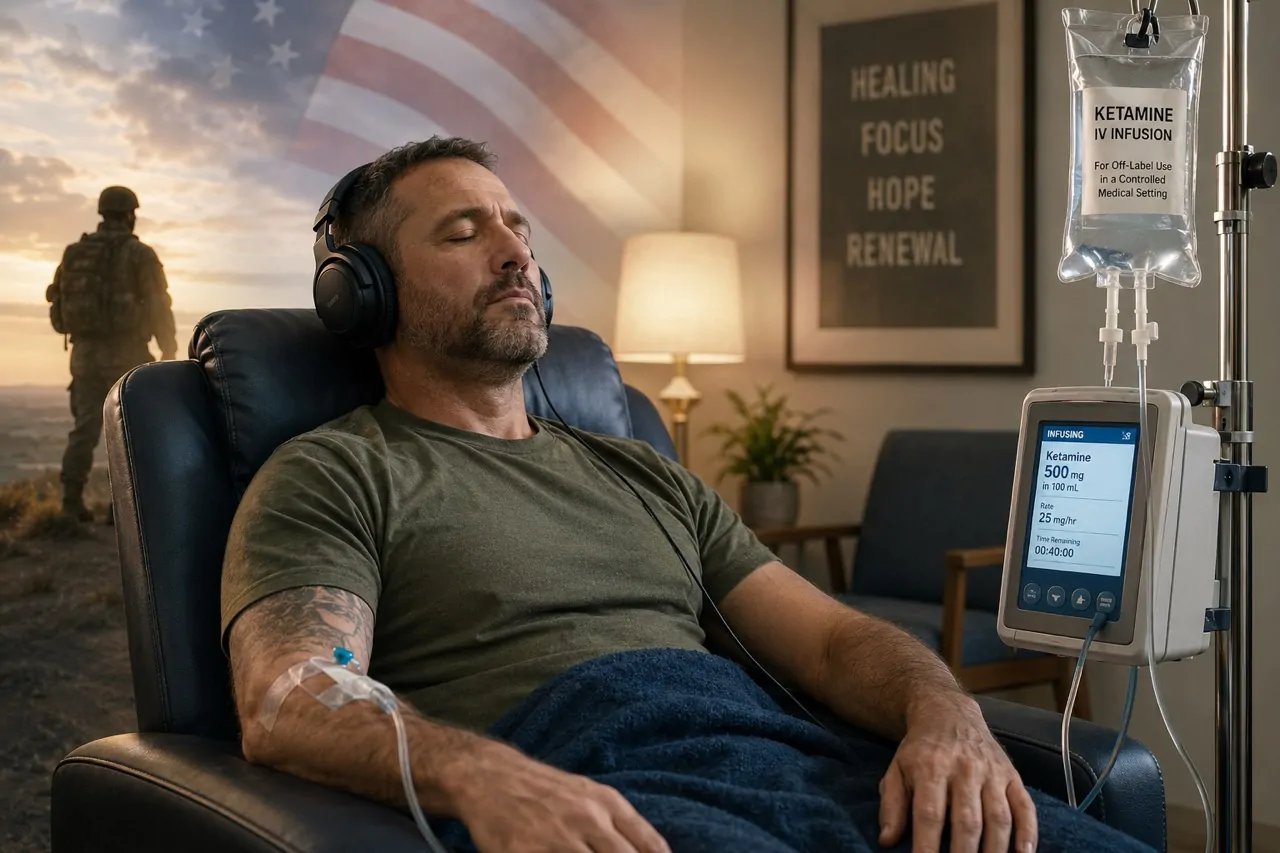
- The sessions. IV ketamine is given slowly through an intravenous line in a private, monitored room, with a licensed clinician present throughout. IV sessions run 40 to 60 minutes. Vitals are tracked continuously. You will experience dissociation, which for some combat veterans surfaces material without warning.
- Safety and monitoring in this population. Two things get extra attention with combat veterans. Dissociation can be disorienting in a way that resembles a flashback for some patients, so we discuss this specifically beforehand, and staff stays present throughout. And ketamine is a Schedule III controlled substance, which matters given elevated substance use rates in this population.
Our Clinical Director, Roland Verfaillie, Ph.D., spent part of his career as the first civilian Director of Community Services for the US military garrison in Augsburg, Germany, and as a Supervisory Psychologist for the Department of Defense. He has worked with this population before.
Insurance Coverage and Treatment Costs
Understanding the financial aspect of ketamine therapy for combat PTSD veterans Florida patients consider is an important part of the decision-making process. Because IV ketamine for PTSD is an off-label treatment and is not approved by the U.S. Food and Drug Administration (FDA) for PTSD, it is generally not covered by most insurance plans.
This reflects how insurance coverage is determined and is not specific to Allay Health & Wellness. We currently accept Medicare, Cigna, United Healthcare, and Aetna, and our team verifies available benefits before scheduling any appointment. You will receive a clear cost summary before making a treatment decision. Veterans should also explore all available VA mental health resources before paying out of pocket.
Eligible individuals may qualify for care through the VA Community Care program, although eligibility is determined solely by the Department of Veterans Affairs. Speaking with your VA mental health provider or local Vet Center can help you understand every available option before considering ketamine therapy for combat PTSD veterans Florida.
FAQs about Ketamine Therapy for Combat PTSD Veterans Florida
- Does the VA cover ketamine therapy for combat PTSD veterans Florida clinics provide?
VA Community Care eligibility is determined by the U.S. Department of Veterans Affairs based on your individual circumstances. Coverage cannot be assumed. Speak with your VA provider or patient advocate before making treatment decisions. - Does ketamine therapy for combat PTSD veterans Florida providers actually offer?
The largest VA and Department of Defense-funded randomized trial did not demonstrate a significant improvement in PTSD symptoms. It did show improvement in depression symptoms, making careful patient selection especially important. - Why would ketamine therapy for combat PTSD veterans Florida still be considered?
Many combat veterans experience both PTSD and treatment-resistant depression. While evidence for PTSD remains limited, some research suggests ketamine may help the depression component in carefully evaluated patients with appropriate clinical oversight. - I have a history of traumatic brain injury (TBI). Can I still be evaluated?
Yes, although a prior TBI requires additional assessment. Your clinician will review your blast exposure, head injury history, neurological symptoms, and previous evaluations before determining whether further testing is appropriate. - Is ketamine approved by the FDA for PTSD?
No. IV ketamine is an off-label treatment and is not approved by the U.S. Food and Drug Administration (FDA) for PTSD or any psychiatric condition. Spravato® is also not FDA-approved for PTSD. - Should I stop receiving care through the VA if I pursue ketamine treatment?
No. Continuing care with your existing VA providers is important. At Allay Health & Wellness, treatment recommendations are coordinated with your healthcare team whenever appropriate rather than replacing ongoing psychiatric care. - What happens if I am not a candidate for treatment?
If our evaluation indicates treatment is not clinically appropriate, we will explain why and discuss evidence-based alternatives. Every recommendation is based on your medical history, current symptoms, safety considerations, and individual treatment needs.
Schedule a Consultation for Ketamine Therapy for Combat PTSD Veterans Florida
If you have completed trauma-focused psychotherapy, tried recommended medications, and continue to experience persistent symptoms, it may be time to discuss whether ketamine therapy for combat PTSD veterans Florida is appropriate for your individual situation. At Allay Health & Wellness, every recommendation begins with a comprehensive psychiatric evaluation rather than an assumption that ketamine is the right next step. Because ketamine therapy for combat PTSD veterans Florida is an off-label treatment, we will explain what current research supports, where the evidence remains limited, and whether another evidence-based approach may better fit your needs.
If we do not believe treatment is clinically appropriate, we will tell you honestly and discuss alternative options. Allay Health & Wellness treats adults 18 years of age and older. Contact our team to schedule a confidential consultation and learn more about our broader mental health services.
Address: 11000 Prosperity Farms Rd, Suite 101, Palm Beach Gardens, FL 33410
Email: [email protected]
Phone: (561) 421-6444
Medical Disclaimer: This article is educational only and not a substitute for professional medical advice. IV ketamine for PTSD is an off-label use, not FDA-approved for any psychiatric condition. Spravato is not approved for PTSD. The largest veteran-specific randomized trial did not find significant effects on PTSD symptoms. Trauma-focused psychotherapy remains first-line. Outcomes vary and are never guaranteed. All treatment requires evaluation by a licensed clinician. Allay treats adults 18 and older.
Reviewed by Nicholas Marino, MBA, Co-Founder and CEO, Allay Health and Wellness